Explore the craftsmanship and wonder behind Griffith Observatory’s new permanent exhibit
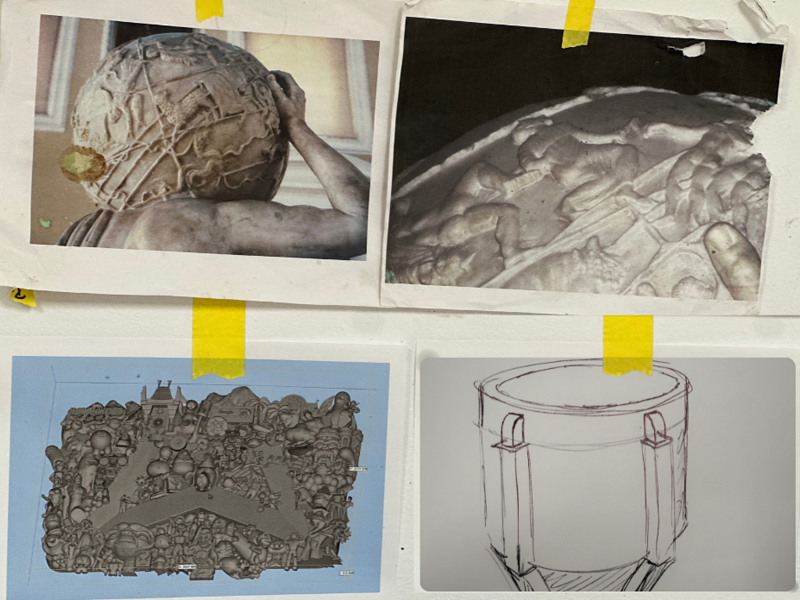
Designer Cindy Ingraham Keefer’s 3D digital model of the Celestial Globe exhibit.
The Celestial Globe debuts to the public on Tuesday, January 27, at Griffith Observatory. We can’t wait to welcome you, your friends, and your families to witness this monumental new exhibit in person.
We’re thrilled to give you an exclusive sneak peek at the skill, dedication, and teamwork that propelled this extraordinary exhibit from initial concept to captivating reality. Keep scrolling for key facts and a never-before-seen glimpse of the production and installation process.
What is the Celestial Globe?
The new exhibit is a four-foot diameter rotating sphere weighing roughly 800 pound sand mounted on an 18-foot pole in Gravity’s Stairway at Griffith Observatory. It depicts 46 Classical constellations—each one meticulously designed, constructed, and then cast in bronze.
Symbolically, the Celestial Globe links the ancient skies to today’s cosmic perspective.
Past, Present, and Future
The Globe echoes the celestial sphere held by the Farnese Atlas, a second century Roman sculpture with constellations carved as the ancients imagined them.
Each year, 1.5 million visitors—including the 28,000 fifth-grade students who attend the Observatory’s In-person School Program—will get to experience it.
Future generations will continue to find inspiration from one of our oldest endeavors: our enduring human effort to understand the sky.
The Observatory’s Levels
Originally conceived as part of Griffith Observatory’s extensive renovation and expansion completed in 2006, the exhibit links the Observatory’s Historic Level and The Gunther Depths of Space.
As a result, it bridges the millennia-long experience of the sky as seen from Earth with the universe as revealed through modern instruments and space exploration.
Beauty and Engineering
The bronze constellations were created with a rare fusion of ancient and modern techniques. Fabricators followed a lost-wax casting process utilizing 3D-printer molds.
The team achieved the ambitious goal of making the sphere rotate. Its motion echoes the way the ancients imagined the heavens turned in Atlas’s grip.
The Celestial Globe began with inspiration from the Farnese Atlas and evolved through sketches, special on-site photography, detailed research, and collaboration.
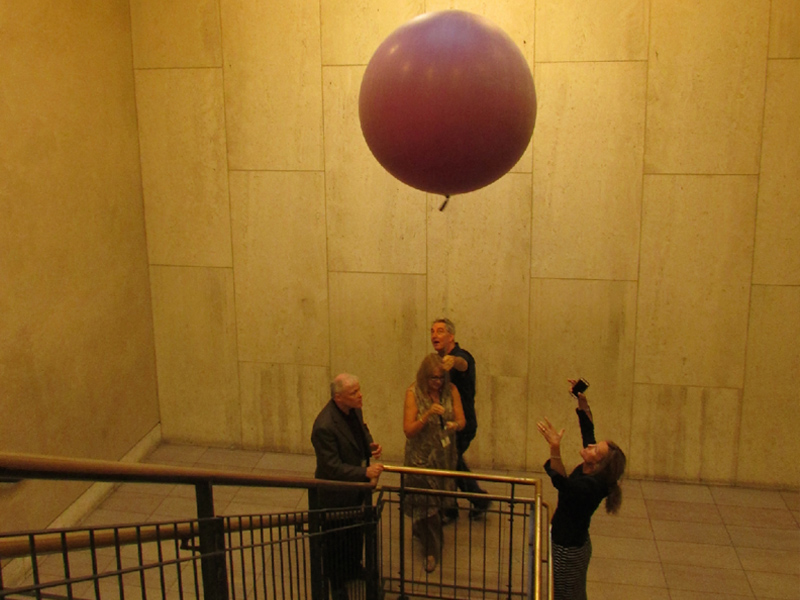
As early as 2015, the team conducted a balloon test to visualize how an object of this size would look in Gravity’s Stairway at Griffith Observatory.
Who made the Celestial Globe?
This remarkable work was brought to life by
• Designer Cindy Ingraham Keefer
• Fabricators Patrick Rees and Eduardo Ortiz of The Big New
• Structural engineer Ken Wong, M.Eng., S.E., of Miyamoto
• Griffith Observatory Director Dr. E.C. Krupp
This exhibit is sponsored by The Ahmanson Foundation and the Eisenberg Foundation.
The exhibit team, Observatory staff, and Foundation partners have been working diligently to complete the Celestial Globe—from precise assembly to careful installation. This initiative has required project management, conceptual vision, 3D modeling, structural design, fabrication expertise, and countless other skills.
It also reflects the community and support from readers like you that make Observatory projects and programs possible.
Every effort has been guided by a shared commitment to the mission of Griffith Observatory: Inspiring everyone to observe, ponder, and understand the sky.
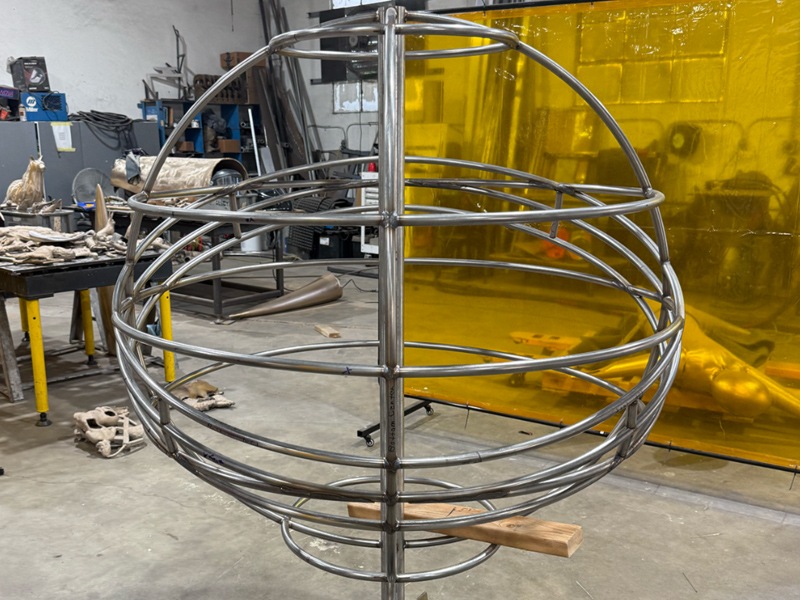
At The Big New in 2025, the foundational structure of the Celestial Globe took shape. The rings are made of stainless steel.
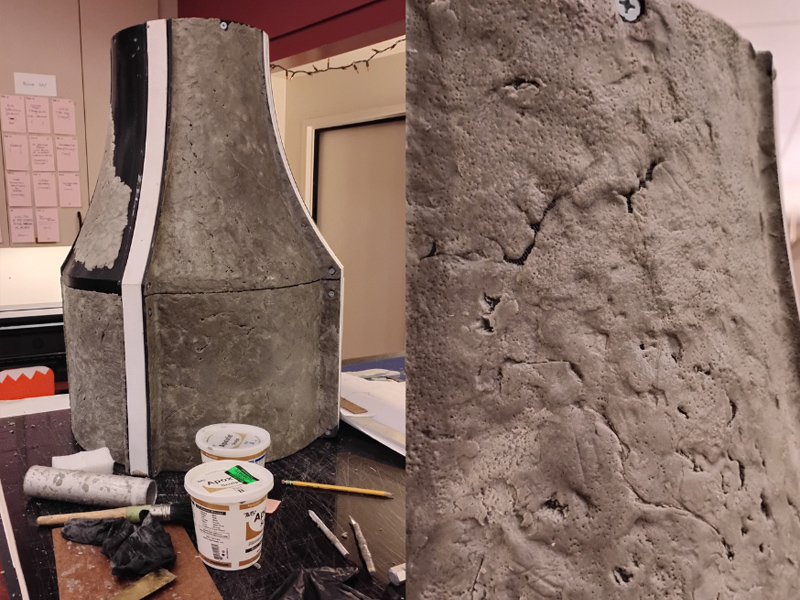
The Globe rotates thanks to an internal motor, cleverly disguised under a stone-like cover designed by Griffith Observatory Art Director Chris Butler.
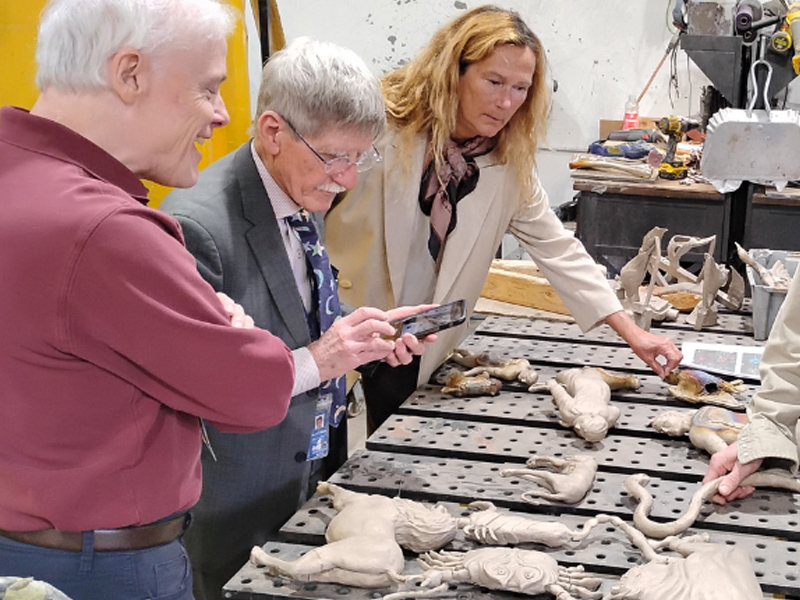
The team visited The Big New throughout the fabrication to track progress. Griffith Observatory Deputy Director Mark Pine, who served as Project Manager, joined Griffith Observatory Director Dr. E.C. Krupp and designer Cindy Ingraham Keefer to review the figures representing the 46 Classical constellations.
What makes the Celestial Globe special?
Every detail of the Celestial Globe was approached with care for both science and storytelling. The result is not just a striking new exhibit, but something people will experience visually and emotionally.
In a world that moves faster than ever, the exhibit is an invitation to slow down, look up, and feel part of something bigger than ourselves. It offers us a rare reminder that wonder is timeless.
For students, families, lifelong learners, and first-time visitors alike, the Celestial Globe fulfills the Observatory’s purpose of making astronomy tangible, accessible, and alive.
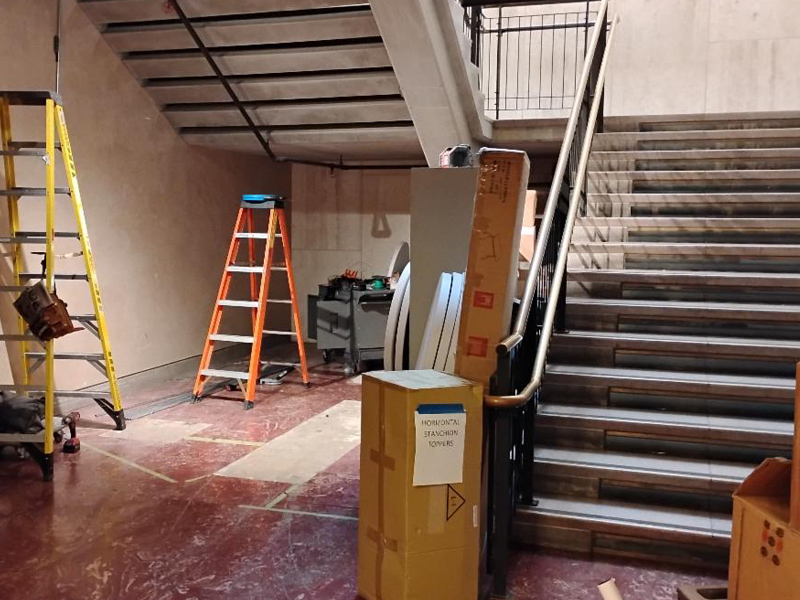
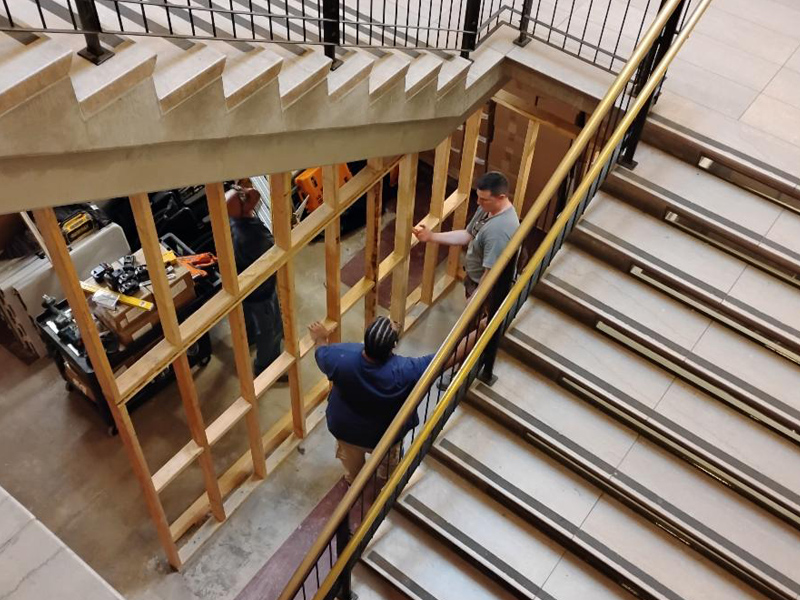
Gravity’s Stairway, typically a central passageway between the building’s levels, became a construction zone.
From scratch, professional Observatory staff closed off the area beneath the stairs and created a separate, dedicated home for the Globe’s supporting pole.
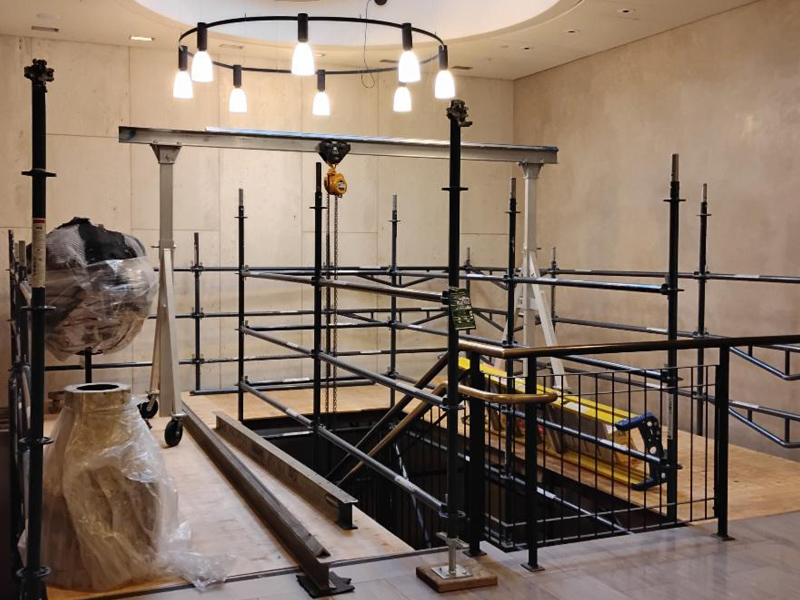
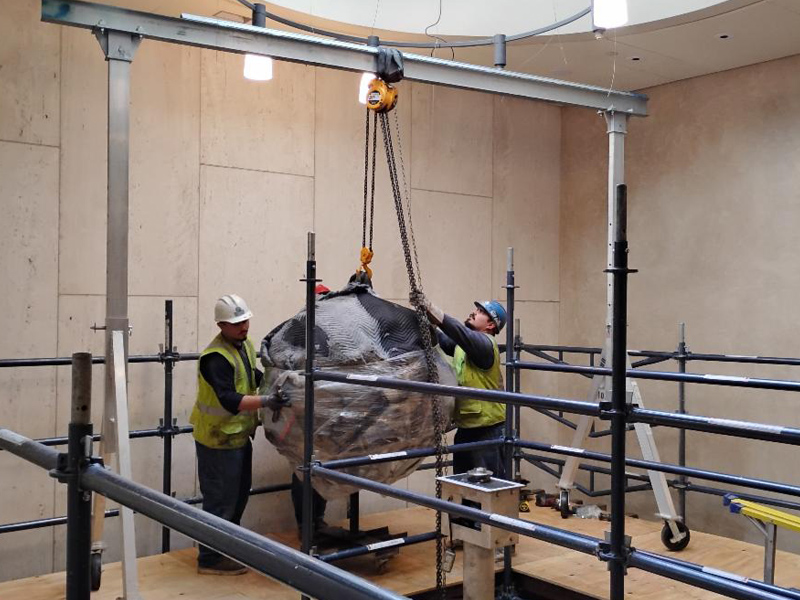
Upon arrival, the Celestial Globe was wrapped in protective covering. Staff and installation contractors United Riggers worked from scaffolding to prepare for installation.
United Riggers staff carefully lift the 800-pound sphere for mounting. The Celestial Globe remains under wraps—literally—until its debut.